CN
CN May 20, 2026
You know the sound before you see it—the faint crinkle as a freshly laminated sheet hits the outfeed tray, followed by that sinking feeling when you spot the first bubble. A tiny blister trapped under the film. Then another. And another. Within seconds, an entire batch is headed for the reject pile, and the line operator is already dreading the root-cause conversation.
If you run a print finishing operation, you’ve likely lived this scenario more times than you’d like. The immediate instinct is to chase ghosts: adjust the roll pressure, swap film suppliers, or blame humidity. Yet in over two decades of troubleshooting film-substrate marriages across everything from lightweight decorative foils to heavy-gauge industrial panels, I’ve found that the real culprit almost always hides in plain sight—temperature. Not just the setpoint on the display, but the entire thermal behavior of the machine from warm-up to full production speed.
Why bubbles form: It’s not just “not enough heat”
A lamination bubble is essentially a pocket of gas or vapor that fails to escape the bond line before the adhesive solidifies. In thermal lamination, the film’s adhesive layer must reach its activation temperature—typically between 85°C and 130°C depending on the chemistry—and maintain sufficient fluidity to wet out the substrate completely. When temperature falls short, viscosity stays high, air can’t be pushed out, and you get voids. What’s less obvious is that excessive temperature causes problems just as severe. Overheating can boil off low-molecular-weight components in the adhesive, create volatile gases that form micro-bubbles, or even oxidize the surface and weaken bonding strength. The Institute of Packaging Professionals has documented that thermal-related adhesion defects account for over 60% of all film lamination failures in folding carton and commercial print applications.
The challenge deepens when you factor in substrate thermal mass. A 400 gsm board, a metallized PET film, and a tissue-thin release liner each pull heat from the nip at dramatically different rates. The roller surface might read a steady 105°C, but at the adhesive-substrate interface, the actual temperature can dip 15–20°C for a split second at higher line speeds. That gap is where bubbles are born.
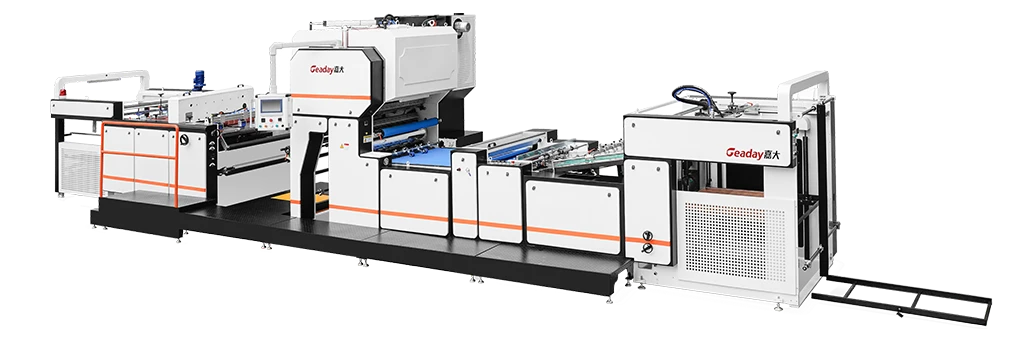
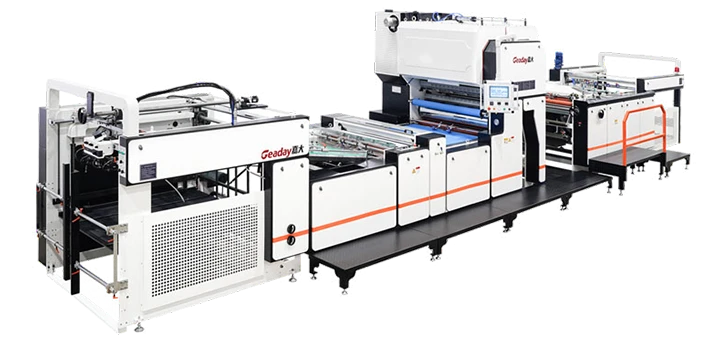
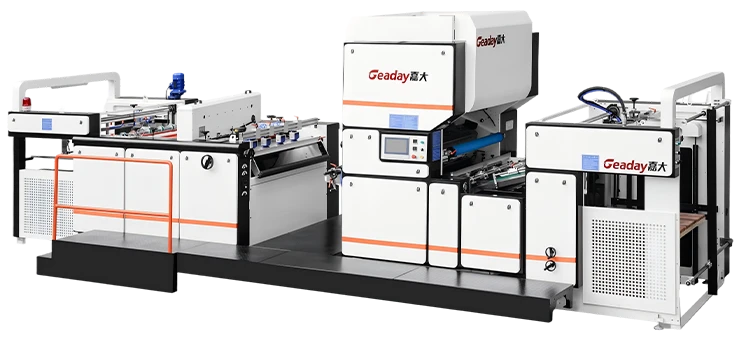
To close it, you need a heating architecture that not only hits a target value but dynamically compensates for substrate draw and speed changes. This is where the design philosophy of the laminating equipment itself becomes decisive. For print providers scaling up their capacity, precision-heated vertical laminating systems designed for continuous-duty finishing offer a fundamentally different approach to thermal stability compared to entry-level horizontal alternatives—but more on that in a moment.
The thermal triad: Setpoint, uniformity, and recovery
Resolving lamination bubbles permanently requires looking at three aspects of temperature control.
1. Setpoint accuracy and ramp-up discipline
Every morning in a busy laminating department, the first few dozen sheets often carry the highest defect rate. The reason is simple: the rollers have not yet reached thermal equilibrium. Many operators set the machine to the target temperature and start running as soon as the controller beeps, but surface probes may still lag the core by 20°C or more. A strict warm-up protocol—typically 20–30 minutes of idle heating with the rollers turning at slow speed—pays for itself tenfold. Some high-end systems now incorporate thermocouple arrays that report both surface and sub-surface temperatures in real time, preventing production from starting until every zone is within a tight ±1.5°C window. That kind of interlock eliminates the human-factor variability that plagues manual processes.
2. Cross-roller uniformity and edge losses
Even when the setpoint is perfect at the roller center, edges often run cooler because they radiate heat to the frame and ambient air. A 10°C gradient across a 1,600 mm roller is not unusual on poorly designed machines, and it shows up as repeating bands of bubbles near one or both edges of the web. The fix involves active edge-heating cartridges, internal roller profiles that compensate for thermal expansion, or, in more advanced configurations, multiple independent heating zones with PID control across the roller length. When evaluating equipment, ask whether the manufacturer publishes cross-width temperature deviation data verified by third-party thermal imaging—not just a single-point reading.
3. Recovery speed during transient loads
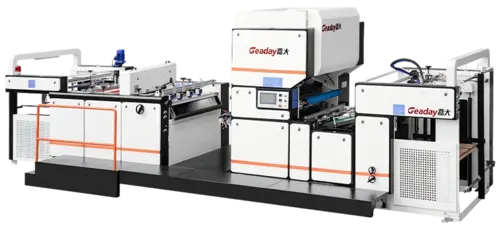
The moment a cold substrate hits the nip, it siphons heat from the roller surface. The recovery time—how quickly the roller returns to setpoint—determines the maximum run speed you can sustain without generating bubbles. Recovery is a function of heating element watt-density, roller material thermal conductivity, and the control algorithm’s responsiveness. A robust heating circuit with correctly specified capacity will recover in under three seconds after a substrate-induced dip. At that point, the precise thermal delivery becomes less about peak temperature and more about thermal inertia and control intelligence. Many operators find that vertical laminating solutions with multi-zone PID and real-time temperature mapping significantly narrow the gap between theoretical throughput and real-world defect-free output because they actively fight these micro-second thermal dips.
Putting it into practice: A 5-point checklist
Through dozens of process audits across commercial and packaging operations, I’ve distilled a practical methodology that consistently reduces lamination bubble rates by over 80%:
-
Profile your actual nip temperature, not the controller readout. Use an external contact probe or thermal imaging to map roller surface temperature at three points: left, center, right, and at warm-up plus 30 minutes.
-
Match adhesive activation range to substrate thermal demand. Lightweight papers need a lower thermal input; heavy boards require pre-heating or slower line speeds. Ask your film supplier for the DSC (differential scanning calorimetry) curve of the adhesive and align your temperature window accordingly.
-
Maintain and calibrate sensors quarterly. A thermocouple that drifts by 3°C can silently destroy yields. Build calibration checks into your preventive maintenance schedule and document baseline readings.
-
Control the pre-lamination environment. Storing film and substrate at consistent temperature and humidity (ideally 20–23°C, 45–55% RH) prevents thermal shock at the nip. Even a 10°C difference between film and substrate can generate transient bubbles.
-
Verify uniformity at running speed, not just idle. Run a continuous test sheet and measure bond strength and bubble count at full production speed. If defects increase disproportionately with speed, it’s almost always a recovery-speed problem.
When good process meets the right platform
No amount of process discipline can compensate for a machine whose thermal design is fundamentally underpowered. I’ve seen shops spend months tweaking their settings only to discover that the heating elements simply lacked the wattage to maintain consistent temperature at their target speed. The best-performing lines I’ve evaluated share a few traits: they separate heating and lamination into clearly defined thermal stages, they eliminate cold spots at the roller edges through intelligent element placement, and they give operators full visibility into real-time thermal data rather than hiding it behind a single numeric display.
If your current setup still produces intermittent bubbles despite following the checklist above, it may be time to look at the system architecture itself. Jiada’s approach to laminating technology centers on active temperature management across the entire roller width, with built-in diagnostics that alert operators to thermal anomalies before they translate into visible defects. Their integrated vertical laminating equipment for high-consistency finishing is engineered to address precisely the triad of setpoint accuracy, uniformity, and recovery speed discussed here. For operations that run multiple shifts with frequent substrate changes, that kind of thermal resilience can shift the economics meaningfully.
Of course, temperature control is only one variable in a complex lamination ecosystem, and every shop has its unique substrate mix and throughput targets. But if you fix the thermal foundation first, the rest of the parameters become far more forgiving.
Note: The temperature ranges and defect-rate estimates cited in this article are based on publicly available industry data, including TAPPI technical papers and supplier documentation. Always validate recommendations against your specific materials and equipment. This article is intended for informational purposes and does not replace hands-on process engineering.