CN
CN Jun 23, 2026
Walk any supermarket aisle, and flexible packaging is quietly winning. Stand-up pouches for granola, resealable films for cheese, mono-material sachets for detergent — the shift is no longer about single-use convenience. It is about performance, shelf appeal and, increasingly, a recyclable end-of-life story. For converters, this is both a growth signal and a stress test: how do you double output, handle ever-thinner webs and meet brand owners’ sustainability targets without burning out aging machinery?
According to Smithers’ The Future of Flexible Packaging to 2028, the global flexible packaging market is set to grow at a compound annual rate of over 4%, with the Asia-Pacific region and sustainable structures acting as the twin engines. What is rarely discussed outside the plant floor is the strain this places on the lamination department — the hidden heartbeat of any converting operation. When a three-layer barrier laminate shifts from a proven PET/Alu/PE structure to a recyclable PP-based monomaterial, everything changes: adhesion windows narrow, heat sensitivity spikes, and running speeds that were once routine suddenly become a quality gamble.
This is precisely why many mid-size and large converters are now scrutinising their finishing assets. The conversation has shifted from “can the machine run this job?” to “how fast, with how little waste, and can it switch between solvent-based and solventless processes in a single shift?” In this climate, high-speed web converting and laminating systems built around modular configurations are moving from a nice-to-have to a commercial necessity.
Speed alone is not the answer — but automation might be
Ask an experienced laminator operator, and they will tell you that top speed on a brochure is rarely the speed you can actually run. The real bottleneck sits in the transitions: splicing a new roll, washing a coating head between chemistries, stabilising tension after a splice. Some machines run at 400 m/min but lose 20 minutes every reel change. That 20 minutes, multiplied across three shifts, eats more margin than any incremental speed gain can recover.
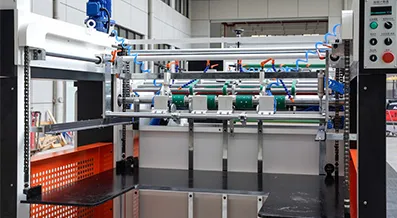
Modern web handling systems attack this in three ways. First, fully automatic splicing — both at the unwind and rewind — that maintains tension within a tolerance of ±1% even on 6-micron aluminium foil. Second, cassette-based coating trolleys that allow an operator to swap from a gravure coating setup to a smooth-roll solventless unit in under 15 minutes, without tools. Third, closed-loop registration that corrects lateral drift at micro-second speed, effectively decoupling speed from accuracy.
The commercial impact is tangible. A converter in Southeast Asia recently documented a 22% increase in net daily output after upgrading to a line with automatic splicing and quick-change coating cassettes. Their waste rate on thin PET/aluminium structures dropped from a typical 3.8% to under 1.2%, primarily because every splice was a controlled event rather than a human reflex test. The facility now runs three different adhesive systems on the same frame — solvent-based for high-barrier retort structures, solventless for dry food pouches, and water-based for a growing mono-material segment — without scheduling nightmares.
When you evaluate equipment, it helps to look beyond maximum speed and ask for splice-time guarantees, waste-rate curves at real running tensions, and video of a genuine changeover from the plant floor — not an edited highlight reel. These metrics separate machines that look impressive in a catalogue from machines that make money in production. For a closer look at how modularity supports rapid chemistry switching, precision coating and laminating machinery now routinely integrates trolley systems originally developed for high-end pharmaceutical applications, bringing a new level of flexibility to flexible packaging.
Sustainability rewrites the lamination rulebook
The pressure to eliminate solvent-borne adhesives is not just regulatory — it is contractual. Major brand owners have published timelines for removing volatile organic compounds from their packaging supply chains, and the EU’s Packaging and Packaging Waste Regulation is tightening allowable emissions at converting sites. As a result, solventless and EB-cure laminating are no longer niche options; they are becoming the default.
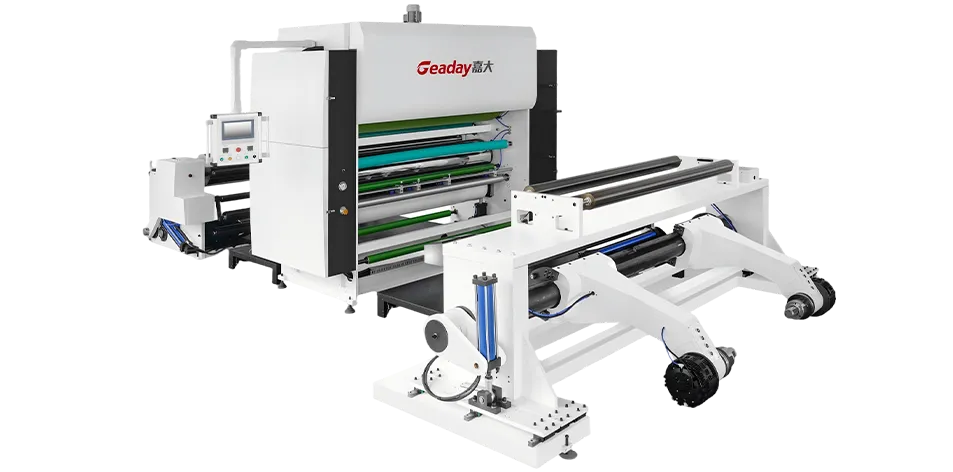
The technical shift, however, is far from trivial. Solventless adhesives require extremely precise coating weight control — often in the 1.0–1.8 g/m² range — because there is no solvent carrier to level out irregularities. A deviation of 0.2 g/m² can mean the difference between a laminate that survives a retort cycle and one that delaminates in the distribution chain. Today’s roll-to-roll laminating lines address this with multi-roll transfer systems and gravimetric mass-flow monitoring that continuously adjusts pump output to match line speed. The best-performing setups maintain coating weight variability below 0.1 g/m² at 450 m/min, even on extensible films.
There is a hidden benefit converters often discover after making the transition: energy savings. Solvent-based lines require thermal oxidizers or solvent recovery systems that consume enormous amounts of natural gas. Removing the drying tunnel from the equation can cut a line’s total energy footprint by 40–60%, turning a sustainability mandate into a genuine operational cost reduction. One independent life-cycle analysis by the German packaging institute IVLV found that switching from solvent-based to solventless laminating reduced cradle-to-gate CO₂ emissions by roughly 35% per 1,000 m² of laminate, even before accounting for logistics improvements.
These environmental and economic drivers explain why the next generation of roll-to-roll laminating lines is increasingly designed as solventless-first, with optional solvent-based stations rather than the other way around. The machinery is adapting to where the market is heading, not where it has been. For teams looking to benchmark their current setup against these new benchmarks, Geaday’s advanced lamination technology offers configurable platform designs that let converters start with a pure solventless line and add coating stations later — an approach that matches capital expenditure to evolving customer orders.
The data thread that ties speed, quality and sustainability together
If there is one quiet revolution happening inside converting plants, it is the move from experience-based to data-informed decision making. Digital thickness gauges, inline spectrophotometers and tension load cells now stream terabytes of data to dashboards that any shift supervisor can read. The goal is not to replace the operator’s intuition — a skilled operator can feel a bearing problem before a sensor detects it — but to catch what intuition misses: a gradual drift in coating weight across a shift, a rising unwind tension signature that predicts a splice failure before it happens.
This connectivity is beginning to rewrite maintenance schedules. Instead of changing bearings at fixed intervals, predictive algorithms can flag an impending failure 48 hours in advance, allowing maintenance teams to replace the part between jobs rather than during one. Early adopters report unplanned downtime reductions of 30% or more. For converters running just-in-time deliveries to food brand fillers, that level of reliability is as valuable as raw speed.
What makes this genuinely useful, rather than just a buzzword, is standardisation. Protocols like OPC UA are making it possible to pull data from laminating stations, extruders, slitters and even warehouse systems into a single analytics platform. This is where the industry is heading: a connected converting floor where a production order triggers automatic recipe downloads, adhesive viscosity checks and inline quality parameters — all before the operator touches the unwind spindle.
Where to go from here
The flexible packaging market is not just growing — it is fragmenting. Short runs of custom structures are becoming the norm, driven by e-commerce brands that want a distinct unboxing experience and a minimalist environmental footprint. This plays against the traditional advantage of long, uninterrupted runs. Converters that thrive in this environment will be those whose lamination equipment is quick to configure, light on waste and heavy on data.
If the numbers from your current line no longer add up — waste creeping above 2%, changeovers eating into available production time, or the inability to bid on solventless-only tenders — the bottleneck is not your team. It is the technology stack underneath them. Take the time to evaluate platforms that were engineered for the material and market realities of the next decade, not the last one. A good starting point is to explore flexible packaging production lines designed with modular coating, predictive monitoring and low-tension web paths as standard features. The difference between incremental improvement and step-change competitiveness often rests on that evaluation.
Disclaimer: Market data referenced is from publicly available industry reports and is provided for context. Equipment performance figures reflect documented best-practice installations and may vary depending on materials, operating conditions and maintenance practices.